Selection, Installation and Application Specifications of Machine Leveling Feet
In injection molding workshops, all types of machinery including injection molding hosts, plastic shredders, water chillers and large auxiliary machines rely on leveling feet to complete horizontal calibration, load-bearing support and vibration reduction. Many workshops only focus on the performance of main machines and auxiliary equipment while ignoring supporting standards for leveling feet. Common problems such as improperly sized selections, unstandardized installation and irregular daily use frequently trigger severe machine vibration, deviation of machining accuracy, abnormal screw noise and misalignment of mold platens, resulting in mass production failures, increased maintenance costs and high defective rates. To guarantee long-term stable operation of equipment, full-process specifications covering leveling foot selection, installation, operation and maintenance must be strictly implemented according to machine dead weight, workshop working conditions and floor conditions, so as to eliminate various mass production hidden dangers from the perspective of basic accessories.
1. Core Basis for Leveling Foot Selection
Proper selection lays the foundation for stable supporting performance, which should be comprehensively determined by three dimensions: load-bearing capacity, material adaptability to working conditions and adjustment stroke.
First of all, match load-bearing specifications. The primary step of selection is to calculate the maximum load per support point, and the rated load of a single leveling foot must reserve a safety margin of over 30% to avoid screw deformation and base cracking under long-term compression. Heavy-duty cast iron base leveling feet are uniformly adopted for large injection molding machines above 1000T with huge dead weight. The wide base disperses ground pressure to prevent local damage to the floor. Reinforced anti-slip models are selected for vibrational auxiliary machines such as shredders and vertical mixers, while standard stainless steel light leveling feet can be applied to light equipment including water chillers and dryers. It is strictly prohibited to support heavy machinery with undersized leveling feet, which will lead to tilting and sliding during operation.

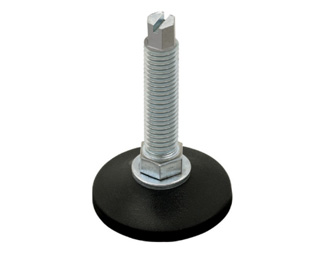
Second, match materials with workshop conditions. Light auxiliary machines in dry oil-free areas adopt 304 stainless steel screws matched with rubber anti-slip bases to realize both rust prevention and vibration reduction. Equipment close to material barrels and heating rings in high-temperature zones is equipped with high-temperature resistant rubber pad models to prevent premature aging of rubber pads under high temperature. Grinding and mixing equipment with continuous vibration is fitted with cast iron bases with anti-slip textures to enhance ground adhesion. Galvanized anti-rust screw leveling feet are selected for humid workshop areas with cooling water leakage and accumulated oil stains, avoiding threaded rust and jamming that hinder later leveling operations.
Third, match adjustment strokes with floor height differences. Select standard short-stroke leveling feet when the floor height difference is within 20mm. For old workshops with floor settlement and height differences over 50mm at joints between old and new floors, long-stroke screw models are adopted. It is forbidden to stack multiple thin iron or plastic gaskets to raise equipment in production, as uneven stress of stacked gaskets easily causes sliding and machine tilting under operational vibration. During selection, sufficient space under equipment should be reserved for cleaning and drainage to prevent long-term accumulation of oil stains and plastic scraps from corroding screws and bases.
2. Standardized Installation Procedures for Leveling Feet
Standardized installation is the key to exerting the leveling and shock absorption functions of leveling feet, divided into three steps: pre-installation ground treatment, integral leveling and special treatment for heavy equipment.
Before installation, clean the equipment placement area first, remove protruding cement lumps on the floor, and sweep away oil stains, plastic dust and waste materials. Repair and polish recessed and damaged floor areas with epoxy mortar to ensure complete fitting of leveling foot bases on the ground without unilateral suspended stress. Check the thread hole specifications of the equipment base. Forcible tapping assembly is forbidden when screw diameter and thread pitch do not match, to avoid thread sliding damage on the base.
For installation of conventional equipment: pre-screw all leveling feet evenly into base thread holes with unified exposed screw length, then translate the equipment to the designated station. Rotate screws slowly to ensure simultaneous contact of four supporting feet with the ground, eliminating three-point support and single-point stress. Use a frame level to measure horizontal levels in transverse and longitudinal directions respectively, fine-tune screws until the horizontal error is controlled within 0.02mm/m. After leveling, lock the bottom anti-loose nut to fix screw height and resist height offset caused by machine vibration during operation.
Additional protective measures are required for heavy equipment such as large injection molding machines. A thickened anti-slip rubber backing plate is added under each leveling foot to expand the stress area and buffer violent vibration generated during mold opening and closing. Re-measure the horizontal level of the clamping table and mold mounting reference surface after rough adjustment. Install anti-loose gaskets for double locking after confirming no tilt to prevent nut loosening during long-term production.
3. On-site Application Specifications and Prohibited Operations
Irregular operation of leveling feet during machine production will directly break the balance state and trigger various equipment failures. During normal production, adjusting height by directly rotating leveling feet under load is strictly forbidden. All leveling and foot replacement operations must be carried out after machine shutdown and main power cut-off. It is prohibited to use extended steel pipes or heavy wrenches to twist screws by force, which easily causes screw sliding and base fracture and loses supporting functions. Random removal of single leveling feet during production is not allowed; three-point support will greatly amplify machine vibration and accelerate wear of guide rails, screws and bearings, shortening service life. Stacking multiple thin gaskets to raise equipment is banned, as sliding gaskets may lead to sudden machine tilting, bringing potential safety hazards such as mold collision and pipeline rupture. During daily production, clean sprue scraps, oil stains and water accumulated around leveling feet in a timely manner to avoid screw corrosion and aging of anti-slip rubber pads, and maintain tight fitting between bases and the ground continuously.
4. Regular Inspection and Maintenance Management Specifications
Normalized maintenance can extend the service life of leveling feet and stabilize machine balance precision. Establish a weekly inspection system: check whether all locking nuts are loose and whether screws have rust, deformation or thread sliding after machine shutdown. Workshop floors will slowly settle under long-term heavy pressure, so re-measure machine horizontal level once a month and re-level and lock nuts in case of tilt. Apply anti-rust lubricating grease to slightly rusted screws, and directly replace jammed leveling feet instead of forced twisting. Replace anti-slip rubber backing plates immediately once cracking, hardening or shedding occurs to prevent machine sliding and shifting during operation. Properly loosen leveling foot locking nuts when equipment is idle for long-term shutdown to reduce long-term compression deformation of screws and lower accessory loss.
Conclusion
Leveling feet are easily overlooked basic accessories, yet they directly determine the vibration amplitude, operation precision and overall service life of injection molding equipment. During selection, specifications of load-bearing capacity, materials and strokes should be matched strictly according to machine dead weight, workshop temperature & humidity and floor height differences. Complete floor leveling pretreatment before installation, implement standardized step-by-step leveling and double anti-loose measures. Avoid all irregular heightening and on-machine leveling operations in daily production, and cooperate with maintenance systems of weekly inspection and monthly re-measurement. Standardized full-process control of leveling feet can effectively reduce mass production problems such as abnormal machine vibration, dimensional deviation of finished products and premature wear of parts, lower equipment maintenance frequency and production costs, and provide basic guarantee for long-term stable production of all kinds of injection molding equipment.
